Like St. Hildegard of Bingen, St. Catherine of Siena experienced episodes of connection and communication with God, sometimes in the form of religious visions, and other times in the form of messages from the Holy Spirit that she felt compelled to pass along to people of her time. Also like St. Hildegard, she was sometimes told in prayer to convey messages to powerful people, in her case to Pope Gregory XI, Pope Urban VI, and other influential figures. In medieval society, it was highly unusual for a woman to dare to approach the Pope, let alone with instructions and advice, yet her messages rang so true that they were accepted as coming from God.
This was a time of political instability, conflict, and chaos, with the rise of warring city-states and tensions between the Pope and secular authorities. St. Catherine’s life can provide us with an example of the power of courageous spiritual practice in the midst of political divisiveness. She also wrote or dictated to her aides a major work of theology, The Dialogue of Divine Providence, based on her mystical experiences of a series of questions and answers in dialogue with God. Because of the profound theology presented in this book, she was recognized as a Doctor of the Church by Pope Paul VI in 1970.
St. Catherine was born into a large, lower-middle-class family of wool dyers in the Italian city-state of Siena in 1347. One day at age six, when she was walking home from an outing with her brother, as they passed the nearby church of St. Dominic, she was suddenly struck by a vision of Christ enthroned in the heavens over the church. She stood, transfixed, unable to move for a time, not hearing her brother’s calls. At age seven, she secretly vowed to remain a virgin for life, dedicating her life to God’s service.
When she was a teenager, her family, knowing nothing of this vow, made persistent efforts to get her to marry her sister’s widower, but she stubbornly refused. Finally at age fifteen, she cut off her long hair in defiance, hoping to make herself unmarriageable. Her family, exasperated, assigned her to do constant housework, treating her like a servant doing menial tasks to the point of exhaustion. They hoped she would tire of the long days of work and choose to marry instead. But St. Catherine simply turned these tasks into a spiritual exercise, imagining to herself that she was serving Jesus, the Blessed Virgin Mary, and the apostles when in fact she was serving her father, mother, and brothers. When not working, she spent time in prayer in her room and giving away food and belongings to the poor, much to her family’s frustration.
Next: Joining the Mantellate, the Order of Saint Dominic for lay women, and more mystical visions.
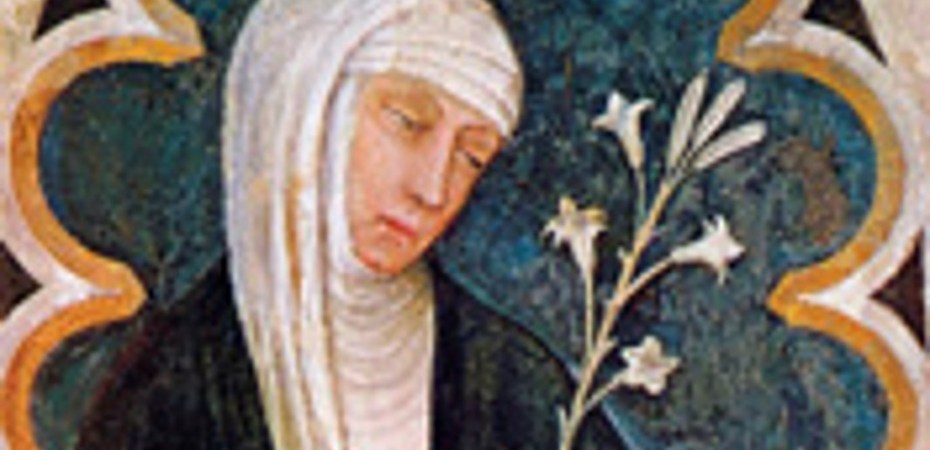
Note: The image in this post is a partial view of a portrait painted by the Italian painter Andrea Vanni around 1400 while she was praying in church. This may be the only contemporaneous portrait of St. Catherine that we have. The original portrait is located in the church of San Domenico in Siena. It is believed that Andrea Vanni was a relative of hers.

