In the year 1373, at age 30 and a half, St. Julian of Norwich became critically ill. After five days near death, she was shown a Cross by the village priest. Focusing with her last energy to gaze on the Cross, she suddenly received 16 “showings,” her word for revelations or visions. These visions gave her teachings about God’s love, and the message that “all will be well.”
Here is an overview of the teachings she received through these visions; for a more in-depth look, please read one of the many translations of her writings, such as this one from Thrift Books: Revelations of Divine Love.
First, St. Julian saw that Jesus’s love surrounds us. Jesus “is to us everything which is good and comforting for our help. He is our clothing, for he is that love which wraps and enfolds us, embraces us and guides us, surrounds us for his love, which is so tender that he may never desert us.”
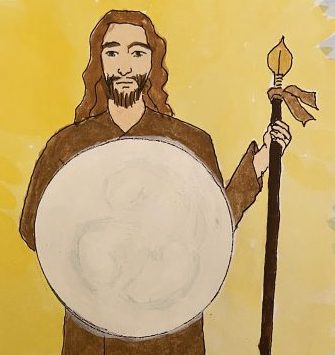
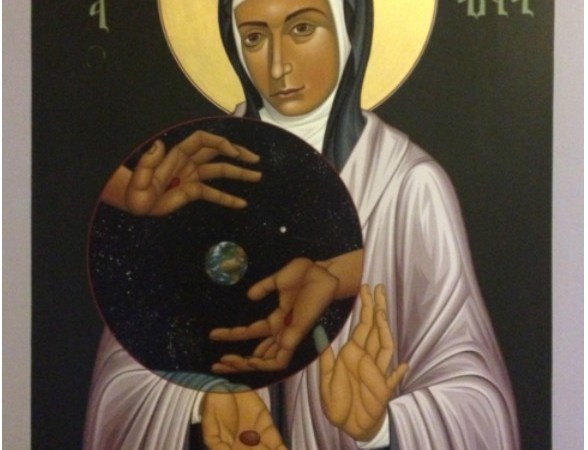
Then she saw that God put a small round thing in her hand, the size of a hazelnut. This small thing was all Creation, “everything that is made.” Through this, she understood that everything has being through the love of God. But seeking worldly well-being in such a little thing does not bring spiritual peace. Instead, it pleases God that we should rest in him, that “a simple soul should come naked, openly and familiarly. For this is the loving yearning of the soul through the touch of the Holy Spirit…”
In a series of visions, she saw Christ’s suffering on the Cross (which is also called Christ’s Passion). She saw great drops of blood coming from the crown of thorns that had been placed on his head. She understood that “He who is highest and mightiest, noblest and most honorable, is lowest and humblest, more familiar and courteous” in order to strengthen and console us. She saw that Jesus, though divine, humbles himself to the human level to comfort us. As the visions continued, she saw Christ’s face and body dehydrate and turn brown and black as he hung from the Cross, and this stage was the worst pain in his long torment. Then suffering gave way to joy, she wrote.
In another vision, Julian saw God “in an instant of time” and understood that “he is present in all things.” She also received the teaching that “nothing is done by chance, but all by God’s prescient wisdom,” and this meant that God guides all things to their best conclusion. Julian wrote that “God is at the midpoint of all, he does everything, and he is incapable of sin. He brings everything, always, to its perfect conclusion.”
One of her most profound visions concerned the nature of sin. Julian, looking everywhere throughout Creation, did not see sin. She realized that sin is “no thing,” since God arranges everything down to the smallest matter. This was an important revelation at a time when medieval society was almost obsessed with the concept of sin, but Julian saw God’s love above all. Later in another vision, God showed her “sin in all its nakedness,” yet even here his unconditional mercy and grace were clear. She concludes, “Our Beloved revealed this vision to me because he truly wants to turn our souls towards him, to contemplate him and his wonderful works.”
Like many medieval Christian mystics, Julian experienced God’s love as motherly. She wrote, “Jesus Christ is our true Mother. We have our being from him, where the foundation of motherhood begins, with all the sweet protection of love which endlessly follows.” She saw that Jesus nourishes us with the Eucharist just as a mother nurses a baby with milk. He is the kind, loving Mother who guards her child tenderly. Even God the Father is both mother and father: “God almighty is our loving Father, and God all wisdom is our loving Mother, with the love and the goodness of the Holy Spirit, which is all one God, one Lord.”
Finally she wrote that Jesus said he can make things well: “The Lord Jesus says, ‘I may make all things well, and I can make all things well, and I shall make all things well, and I will make all things well; and you will see yourself and every kind of thing will be well.'” This was surely a comforting message for someone living through the Black Plague and a time of civil war.
May we also take comfort from these messages in our own tumultuous times.
After her recovery, Julian became an anchoress, which means she was enclosed in a cell with two windows attached to St. Julian’s Church, Norwich. One window opened into the church, so she could participate in the Mass and receive the Eucharist. The other window opened to the outside world, and people came for spiritual guidance and advice. Once enclosed in a cell attached to a church, an anchoress did not leave for the rest of her life. During this time in history, women had few options for study and contemplation, so living as an anchoress, while it amazes us today, was sometimes a preferred option. There she wrote a short and long version of the Revelations of Divine Love. It is believed to be the first full-length book written in the English language.

 Contemplative Prayer Journal