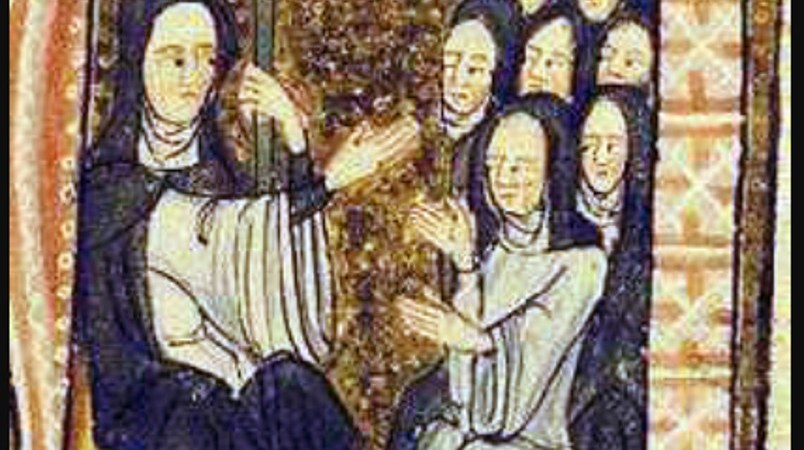
At a time when women’s position in society was subservient to the role of men, St. Hildegard of Bingen was called to be a mystic, visionary, author, painter of her visions, composer of angelic choral music, herbalist, unlikely advisor to popes and clergy, and later, Doctor of the Church.
As St. Hildegard herself wrote, “I have from earliest childhood seen great marvels which my tongue has no power to express, but which the Spirit of God has taught me that I may believe.” As a child, she was considered too religious and “odd” to be marriageable, so at age 10 she was given to the Disibodenberg Abbey where she served the abbess. In 1136 she herself became abbess.
In 1141 at the age of 43, she received a sudden vision commanding her to write what she saw and heard from the Holy Spirit. Her master work, Scivias, was written over a period of ten years, containing more than thirty-five visions with accompanying images. This work, which she described as taking dictation from the Holy Spirit, eventually came to the attention of the Pope and received his approval.
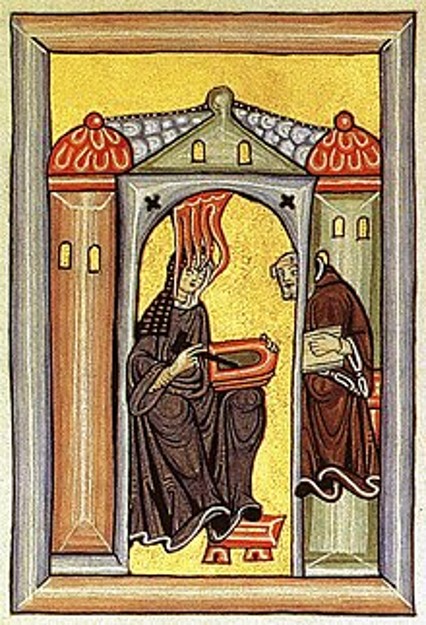
In Scivias she wrote as foreword:
“Declaration: These Are True Visions Flowing from God
“In the forty-third year of my earthly course, as I was gazing with great fear and trembling attention at a heavenly vision, I saw a great splendor, in which resounded a voice from Heaven, saying to me,
‘O fragile human, ashes of ashes, and filth of filth! Say and write what you see and hear. But since you are timid in speaking, and simple in expounding, and untaught in writing, speak and write these things not by a human mouth, and not by understanding of human invention, and not by requirements of human composition, but as you see and hear them on high in the heavenly places in the wonders of God. Explain these things in such a way that the hearer, receiving the words of his instructor, may expound them in those words, according to that will, vision and instruction. Thus, therefore, O human, speak these things that you see and hear. And write them not by yourself or any other human being, but by the will of Him Who knows, sees and disposes of all things in the secrets of His mysteries…Speak therefore of these wonders, and being so taught, write them and speak.’”
As with many of the mystics who came before her and after her, she experienced this command to write down the words she heard from the Holy Spirit, a command that she had resisted until she became ill and the compelling voice became undeniable.
How often do human beings hear or feel the calling of the Holy Spirit to some course of action or to speak some truth. We may need to be called several times before we give in. We may think we are not up to the job, not talented enough, or not good enough. But the Holy Spirit prevails, saying “Say and write what you see and hear.”
More on St. Hildegard in the next post. For further reading, the Wikipedia article on her is excellent.
 Contemplative Prayer Journal