July 10, 2025
Today will begin a series of posts on the medieval women mystic saints. These women can inspire us for many reasons. They exemplified the heart of the Christian spiritual and mystical tradition, and they can show us the way to engaging in mystical prayer ourselves. They were courageous in speaking out and writing about their experiences in a society that could be oppressive or even dangerous, especially towards women, and because they spoke truth, they were often listened to by the people in high positions of power. Each one was very different from the others; yet each one found her own way to connect with God, to write down what they heard from the Holy Spirit (or in the case of Hildegard of Bingen, to also paint what she saw in visions) for the benefit of their contemporary societies. Their writings now echo down the centuries, standing the test of time in imparting their wisdom and practical teachings on the spiritual path.
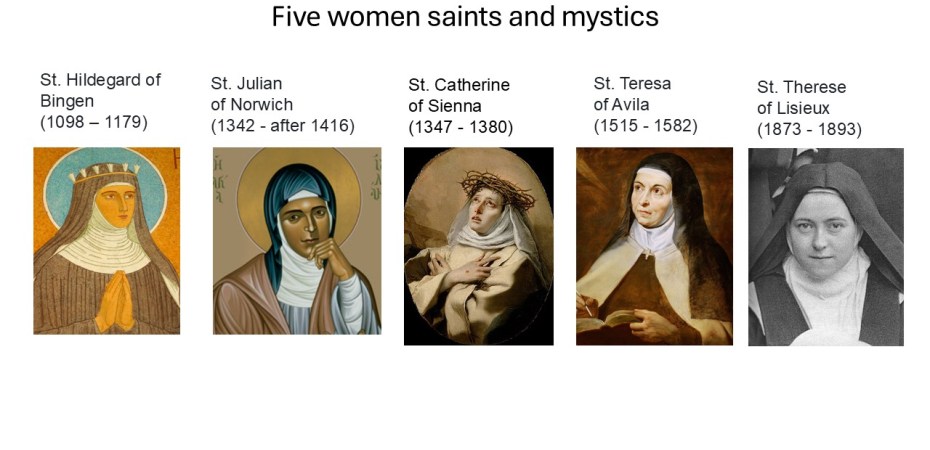
St. Hildegard of Bingen (1098 – 1179), mystic writer, artist, composer of music, and herbalist/ecologist was declared a Doctor of the Church (Catholic), a highest level of recognition, in 2012. She wrote many books including her major work, Scivias, containing messages and instructions she received in prayer that were relevant to society at that time. She also painted images she saw in contemplation, composed choral music (“voices of angels”) that is available on Youtube, expanded her nunnery, and was a master herbalist.
Julian of Norwich (1342 – after 1416) was a British anchoress, which means she lived shut in a cell attached to a church. She wrote Revelations of Divine Love describing mystical experiences she received while very ill was an almost fatal illness. These vivid experiences a full of insights and wisdom received directly from her visions of Jesus who she say in his Passion.
St. Catherine of Sienna (1347 – 1380), was also recognized as a Doctor of the Church. Although receiving no formal education, she wrote The Dialogue, a lengthy book of teachings and became an advisor to popes and political leaders. A wonderful historical novel has been written about her life – Lay Siege to Heaven: A Novel about Catherine of Siena – along with several other books whose links will appear in the unit on her life and teachings.
St. Teresa of Avila (1515 – 1582), also Doctor of the Church, wrote The Interior Castle and other autobiographical books. Her aim in writing was to teach the nuns in her convents about the spiritual and mystical journey using ordinary, everyday language. This practical and inspired guide to the mystical path has likely not been surpassed in more than 400 years since it was written.
St. Therese of Lisieux (1873 – 1893), another Doctor of the Church, has vivid mystical experiences and was prompted to write Story of a Soul. Among the many images in her writing, flowers appear frequently. She is known as The Little Flower; she wrote, “Love proves itself by deeds, so how am I to show my love? Great deeds are forbidden me. The only way I can prove my love is by scattering flowers and these flowers are every little sacrifice, every glance and word, and the doing of the least actions for love.” She inspired millions of people to value small acts of love in their daily lives, which she called “the Little Way,” and among those who were inspired by her were Dorothy Day, founder of the Catholic Workers Movement, who wrote a biography of St. Therese of Lisieux.
More on each of these saints will follow.
 Contemplative Prayer Journal